
Wellness Oils: A Complete Guide to Daily Vitality

Wellness oils are a product category, not a single remedy, and the label can make all the difference. One product may be an essential oil, another a blend or roll-on, and each can have a different intended use and set of precautions. If broad marketing claims and unclear directions have left you unsure what to choose, that caution is sensible: natural-sounding language alone doesn’t tell you what a product contains or how to use it.
This guide explains common wellness oil formats, how to compare their intended uses, and what to check on ingredients, directions, warnings, and advertised benefits. You’ll also find practical steps for reviewing topical products, including why you should follow the specific label instead of assuming every oil is used the same way. Whether you’re considering a botanical blend or a medicated oil, start with the product’s stated purpose and realistic expectations. Wellness oils may be part of a personal routine, but they shouldn’t replace medical advice or care.
Key Takeaways
- Wellness oils can differ widely in ingredients and intended use, so identify what you want from a product before comparing options.
- Compare formats by convenience and label directions, not by assumed benefits.
- Check the complete ingredient list, manufacturer details, directions, and warnings before choosing.
- For topical wellness oils, follow product-specific instructions and consider your own skin sensitivities.
- Use a checklist of purpose, format, ingredients, and safety information to narrow your options without treating an oil as medical care.
What Are Wellness Oils? Understand the Products Behind the Broad Label
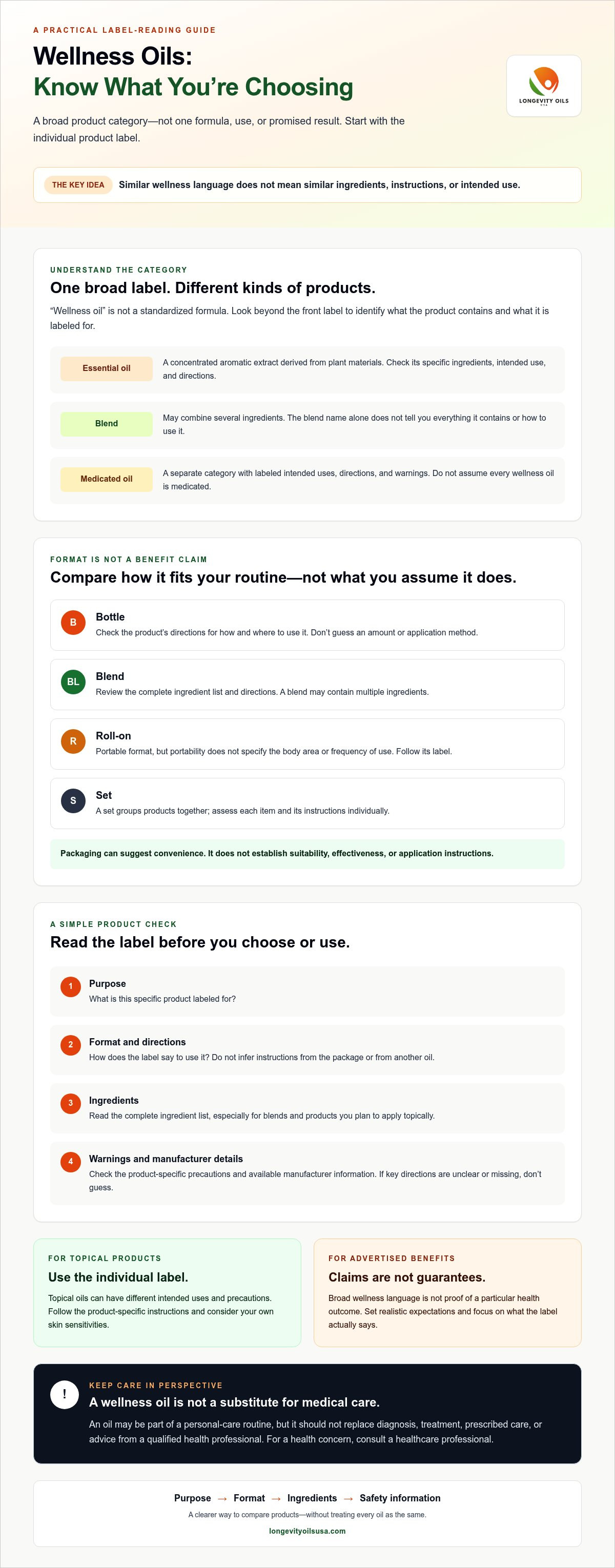
Wellness oils are products marketed for varied personal-care or wellness routines. The phrase describes a broad market category, not a standardized formula. It doesn’t guarantee particular ingredients, a specific purpose, or a health result. Two products carrying similar wellness language may differ in what they contain and how they’re meant to be used, so look beyond the front label.
Some oils are intended for topical use, while others are essential oil blends or medicated oils with their own labeled purposes and precautions. These types aren’t interchangeable. Use the individual product’s intended-use statement and directions, rather than relying on the general category name.
How Do Wellness Oils Differ from Essential and Medicated Oils?
Essential oils are concentrated aromatic extracts derived from plant materials. A blend may combine several ingredients, and a product described as an oil may also include other components. For background on essential oils, including their production and uses, see Essential oil.
Medicated oils are a separate category. Their labels identify intended uses and provide product-specific directions and warnings. Don’t assume every oil marketed for wellness is medicated, or that products with similar names have the same status. Check the current label and manufacturer information for the individual product. In every category, “wellness” is broad marketing language, not proof of a particular health outcome.
Which Formats Might You Encounter?
Format can affect how a product fits into a routine, but it doesn’t establish how effective it is. Bottles, roll-ons, and sets appear across the retailer’s catalog, which includes botanical and medicated oil offerings. A roll-on may be convenient to carry, while a set groups products together. Neither detail tells you which product is suitable for a particular use.
Before choosing, check what each item is labeled for and how its directions describe use. Don’t infer application instructions from packaging alone. For collection-specific information, consult the NANOGIZE Signature Wellness Oil Collection guide, then compare its details with the current product label. This keeps the collection description, packaging, and actual instructions in their proper context.
How Wellness Oils Are Used: Match the Format to Your Routine
There isn’t one application method for every oil. A product may be labeled for skin, scalp, or another specific use, while another may have different instructions altogether. Before using it, look for the intended-use statement, directions, and warnings on that product’s label. If these details are missing or unclear, don’t guess based on the format or a similar product.
Intended use and directions vary by product formulation, so follow the individual label rather than assuming one oil works like another. Intended use can also shape how a product is classified. The University of Minnesota explains how essential oils are regulated according to their intended use and claims. This is another reason to assess the actual product, not just its broad wellness language.
Choosing Between a Bottle, Blend, and Roll-On
A bottle may offer a familiar way to dispense an oil, but check the label for the specific method and amount of use. Don’t assume how many drops to apply or where. Blends can contain multiple ingredients, so review the full ingredient list and directions rather than relying on the blend name. A roll-on is a portable application format, but its convenience doesn’t tell you which body area it’s intended for or how often to use it.
Sets bring multiple products together, but each item still needs to be assessed on its own. For example, the retailer’s catalog includes the SANO Longevity Essentials Travel-Size Wellness Oil Set. Its travel-size format indicates portability, not a particular effect or application method. Check the instructions for every product in a set individually.
Set Realistic Expectations for Everyday Wellness
An oil may fit into a personal-care routine, but it shouldn’t take the place of diagnosis, treatment, or advice from a qualified health professional. Claims about vitality or other outcomes aren’t guarantees. If you’re considering a product to address a health concern, consult a healthcare professional rather than relying on marketing language or changing prescribed care.
For broader context on active aging and mobility, explore this active-aging and mobility guide. As you compare options, focus on what the label actually says: intended use, directions, ingredients, and precautions. You can also browse wellness oil offerings and compare each product’s current label before choosing.
How to Evaluate Wellness Oils: Ingredients, Evidence, and Label Claims
Start with the product itself, not the promise on the front of the package. Look for a complete ingredient list, clear directions, warnings, and manufacturer information. Then compare what the label says with the evidence offered for any specific benefit. A traditional use or botanical name can provide context, but it doesn’t establish that the product will produce a particular result.
A product’s ingredient list and label do not, by themselves, establish clinical effectiveness. Relevant evidence needs to relate to the actual ingredients, formulation, intended use, and claimed outcome. Research on an ingredient in one context may not support a broader claim about a different product.
What to Check on an Oil Product Label
Before selecting a product, confirm that its ingredients are clearly named and its directions explain how it is intended to be used. Review any warnings, application areas, and stated precautions. Manufacturer information can help clarify details that aren’t obvious from the packaging.
If the label is incomplete or a direction is unclear, pause and ask the seller or manufacturer for clarification rather than filling in the gaps yourself. For a useful comparison, check the same details for each product: ingredients, labeled use, directions, warnings, and available evidence for the specific claim.
| Product format | Listed ingredients | Labeled use | Evidence questions |
|---|---|---|---|
| Topical oil in a bottle | Are all ingredients identified? | What application does the label specify? | Does the evidence relate to this formulation and use? |
| Essential oil blend | Are the blend’s components listed? | What directions and precautions are provided? | Do sources support the specific benefit claimed for this blend? |
| Medicated oil or roll-on | What ingredients and product details appear on the label? | What use, warnings, and instructions are stated? | Is there reliable evidence for the stated use of this product? |
How to Read Wellness and Botanical Benefit Claims
Broad statements about general well-being differ from claims that a product can prevent, treat, or cure a disease. Read the wording closely, and be cautious of confident promises that aren’t supported by relevant evidence. A named botanical may be associated with traditional uses or studied in specific settings, but its presence doesn’t guarantee a particular outcome in a finished oil.
For wellness oils, ask whether credible scientific sources support the exact health claim, not merely whether an ingredient has a familiar name. Keep marketing language, traditional context, and research findings distinct. If you’re considering a product for a health concern, don’t treat promotional claims as a substitute for professional medical guidance.
How to Use Topical Wellness Oils More Carefully
Topical use should begin with the product label, not a general rule about oils. Formulas and ingredients vary, and instructions for one product may not apply to another. Read the directions, review every warning, and use the oil only as directed. If the label doesn’t clearly say the product is intended for skin, don’t apply it topically.
What Should You Know Before Applying an Oil?
Check the label for intended application areas and any stated precautions. Don’t assume an oil should be diluted, used on a particular body area, or applied in a certain amount unless the directions for that exact product say so. A familiar format, such as a bottle or roll-on, is not a substitute for instructions.
Keep the product away from eyes, children, and pets unless its label states otherwise, and follow any storage guidance provided. If directions or warnings are missing or unclear, contact the seller or manufacturer before use. Guesswork is not a safe way to fill in product-specific details.
When Is Professional Advice the Safer Next Step?
Skin sensitivity and ingredient responses differ from person to person, so no topical oil can be assumed to be irritation-free. If you notice an unwanted reaction, stop using the product and seek appropriate guidance. For persistent symptoms, existing health concerns, pregnancy, sensitive skin, or questions about a medication or ingredient, speak with a qualified healthcare professional. A clinician or pharmacist can help you consider your circumstances and potential concerns.
An oil shouldn’t delay evaluation or treatment for a health problem, and it shouldn’t replace prescribed care. If you’re considering a product for an ongoing symptom, ask a healthcare professional what steps are appropriate rather than relying on broad wellness claims or informal advice.
- Read: Confirm the product is labeled for topical use.
- Review: Check its directions, warnings, application areas, and precautions.
- Pause: Ask the seller, manufacturer, or a qualified professional if important information is unclear.
Careful label reading helps you assess whether a product fits your routine without assuming that all wellness oils are used alike. To review available oil categories, compare wellness oil products and check each item’s current label before deciding.
Choosing Wellness Oils for Your Needs: A Thoughtful Next Step
A good choice begins with your routine, not a promise on a package. Before comparing products, use this checklist to focus on details that can guide a practical, informed decision:
- Intended use: Is the product labeled for the purpose you have in mind?
- Format: Does its packaging suit how you plan to keep and use it?
- Ingredients: Can you identify what the product contains?
- Directions: Are the instructions clear and specific to this product?
- Safety information: Have you reviewed its warnings and precautions?
The right category depends on what fits your routine and the product’s own directions. A portable set, a botanical blend, and a medicated oil are different options, not interchangeable solutions. Compare labels rather than assuming products with similar wellness language have the same ingredients, intended use, or benefits. If you’re managing a health concern, treat an oil as a possible personal-care choice, not a replacement for professional medical guidance.
Which Longevity Oils USA Products Could Readers Explore?
Longevity Oils USA’s catalog includes the NANOGIZE Signature Wellness Oil Collection, the Nature Gold Nano Oils Premium Essential Collection, and the SANO Longevity Essentials Travel-Size Wellness Oil Set. The catalog also includes the NANOGIZE Special Ginseng Premium Essential Oil Blend Collection and Eagle Global Medicated Roll-On. These are examples of available collections and formats, not evidence of a particular health outcome. Review each current product label to understand its ingredients, intended use, directions, and precautions before deciding whether it suits your routine.
How to Continue Exploring Without Overpromising
If you’re researching ginseng, the ginseng oil reference guide offers a place to continue exploring the topic. Keep any information you find in context: an ingredient’s name alone doesn’t establish how a specific finished product should be used or what it may do.
Choose at a measured pace. Compare the label with your intended routine, and ask the seller or a qualified professional if something important remains unclear. To compare the available collections, explore Longevity Oils USA.
Choose Your Next Step with Confidence
Wellness oils cover distinct product types, so a familiar name or format isn’t enough to determine how an oil is intended to be used. Base your decision on the individual product’s purpose, ingredients, directions, and safety information. Keep expectations grounded: marketing language and botanical ingredients alone don’t establish a health outcome, and oils aren’t a replacement for medical care.
Longevity Oils USA offers the NANOGIZE Signature Wellness Oil Collection, alongside the Nature Gold Nano Oils Premium Essential Collection and travel-size wellness oil sets. These are options to explore, not proof of a particular result. Review each product’s current label and consider whether its stated use fits your routine.
Ready to compare the available collections? Explore Longevity Oils USA’s wellness oil collections.
Frequently Asked Questions
What are wellness oils?
Wellness oils are a broad category of products marketed for personal-care or wellness routines. The term doesn’t identify one standardized formula, ingredient list, or proven outcome. Products may include essential oil blends, topical oils, or medicated oils, and each type can have different directions. Check the specific product’s ingredients, intended use, and instructions rather than assuming that items grouped under this label are interchangeable.
Are wellness oils the same as essential oils?
No, not necessarily. Essential oils are concentrated aromatic extracts, while wellness oils can refer to a wider range of products, including blends, topical oils, and medicated oils. Some wellness products may contain essential oils, but the label determines what a particular product includes and how it’s meant to be used. Review its directions and warnings, and don’t assume one type suits every routine.
Can wellness oils be applied directly to the skin?
Only apply an oil to your skin if that specific product is labeled for topical use, and follow its directions. Formulas and precautions differ, so don’t assume a product can be applied directly or used on any body area. Review the ingredients and warnings first. If you have sensitive skin, a health concern, or questions about whether topical use is appropriate, consult a qualified professional.
How do I choose a wellness oil?
Start with your intended routine, then compare the product’s format, listed ingredients, directions, and warnings. Clear labeling can help you understand what the product is for, while broad benefit language alone can’t establish that it fits your needs. Consider whether its format works for how you plan to use and store it. If key label details are unclear, ask the seller or manufacturer before choosing.
Are wellness oils proven to treat pain or other health conditions?
A wellness or botanical description doesn’t establish that a product treats a medical condition. Evidence and product status may differ, so check specific claims against reliable sources and the product’s own label. Don’t use an oil instead of professional diagnosis or care. If you have persistent symptoms or questions about a health condition, consult a qualified clinician for guidance suited to your situation.
What should I do if a wellness oil causes skin irritation?
Stop using the product and follow any safety instructions on its label. If symptoms are severe, persist, or concern you, contact a qualified healthcare professional or seek appropriate medical care. Keep the packaging so you can share the ingredient list and directions. Don’t resume use or apply the oil elsewhere unless product guidance or a qualified professional indicates that doing so is appropriate.