
Top Longevity Oils for Vitality and Healthy Aging

A bottle labeled for “longevity” can sound like a promise of more years, but the name alone doesn’t tell you what an oil can do. The phrase longevity oils has no consistent scientific meaning across product listings. One formula may be positioned for topical comfort, while another uses broad wellness or healthy-aging language.
Before adding a product to your routine, look beyond its name. An oil may suit a personal wellness practice, but that doesn’t mean it can extend lifespan, prevent disease, or reverse aging. Check the intended use, read the exact label, and separate practical product information from claims that go beyond the evidence.
This guide offers a checklist for comparing longevity oils, including ingredients, directions, formats, and claims to treat cautiously. Whether you’re considering a curated wellness blend such as those from Longevity Oils USA or just learning what to look for, use the label and your intended use to guide a considered choice.
Key Takeaways
- Set a realistic goal before comparing products. A topical wellness experience is not the same as a claim about longer life or slowed aging.
- Compare the full ingredient list, format, intended use, directions, and warnings instead of relying on broad marketing language.
- Research on an ingredient doesn’t prove that a finished blend delivers the same effect. Look for evidence that matches the product and its claims.
- Review the product’s directions and warnings. Don’t guess at an amount or frequency.
- Once you know what you’re looking for, consider the NANOGIZE Signature Wellness Oil Collection as one option to investigate, and confirm its current label details.
What Are Longevity Oils? Define the Term Before You Shop
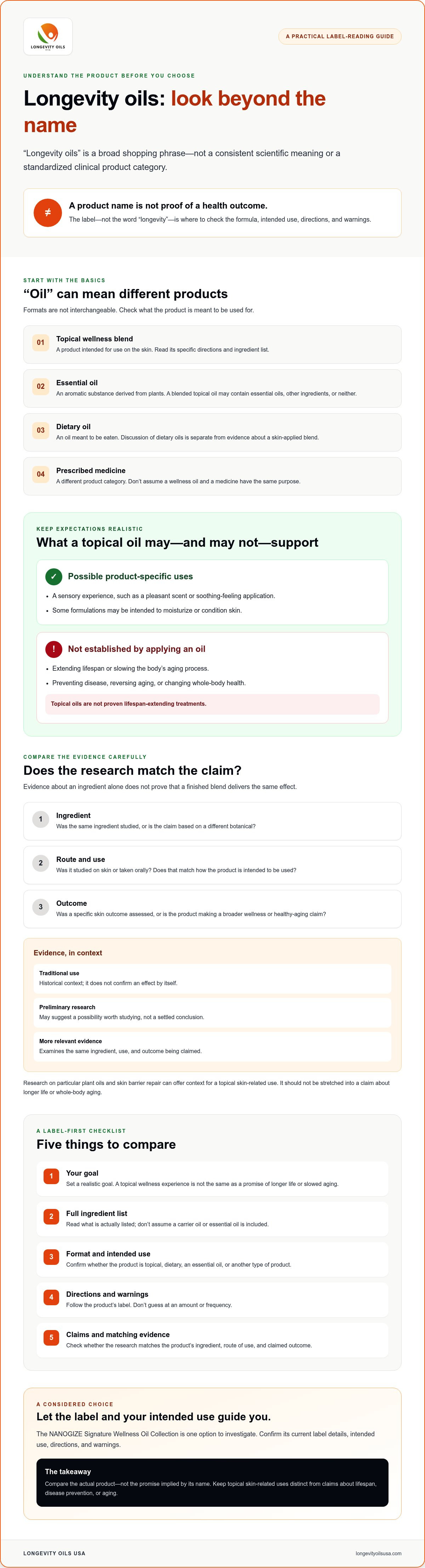
Longevity oils are oils marketed for wellness or healthy aging, but the phrase is a broad shopping term, not a standardized clinical product category. It doesn’t identify a particular ingredient, formula, or proven health outcome. Applying an oil to the skin isn’t evidence that it extends lifespan or slows the body’s aging process.
“Oil” can refer to very different products: a topical wellness blend, an essential oil, a dietary oil meant to be eaten, or a prescribed medicine. These formats aren’t interchangeable. Check the product’s intended use and label rather than assuming its name tells you what’s inside or what it can do.
The video below discusses dietary oils in a longevity context. That’s different from topical oil products, so treat it as a separate conversation about food choices, not as evidence for a skin-applied blend.
What does longevity mean on an oil product label?
“Longevity” may describe a product’s wellness positioning rather than a verified result. Read the full label for ingredients, intended use, directions, and warnings. The product name alone can’t confirm a benefit. Treat promises of longer life, disease prevention, or age reversal with particular care. Those claims go well beyond describing a topical product’s intended use.
How are longevity oils different from essential oils?
Essential oils are aromatic substances derived from plants. A blended topical oil may contain essential oils, other ingredients, or neither. The terms don’t mean the same thing. A general overview of essential oils explains their origins and common uses, but it doesn’t verify the effects of a particular product. A carrier oil may be part of a formulation, but check the ingredient label rather than assuming it’s included.
For a closer look at essential oils and active aging, read this guide to essential oils for active aging. Whether you’re comparing a wellness blend or an essential oil, use the stated ingredients and directions to understand the product.
What Longevity Oils Can Realistically Support, and What Evidence Cannot Prove
A topical oil may offer a sensory experience, such as a pleasant scent or a soothing-feeling application. Certain formulations may be intended to moisturize or condition skin. These are limited, product-specific possibilities, not evidence of changes to whole-body health, the pace of aging, or lifespan.
Topical oils are not proven lifespan-extending treatments. Evidence about an ingredient doesn’t establish that a finished blend works, either. The formula, concentration, combination of ingredients, application method, and outcome studied all matter. For example, a finding about one plant oil and skin comfort doesn’t show that a different blend improves mobility or prevents age-related disease.
A review available through the National Center for Biotechnology Information discusses research on particular plant oils and skin barrier repair effects. That type of evidence may offer context for a topical skin-related use, but it shouldn’t be stretched into a claim about longer life or whole-body aging.
How to read evidence behind botanical oil claims
Start with the claim, then check whether the research matches the ingredient, route, and outcome. Was the same botanical studied on skin, or taken orally? Did researchers assess a specific skin outcome, or a broad wellness claim? These details determine how relevant the research is to the product you’re considering.
- Traditional use offers historical context, but doesn’t by itself confirm an effect.
- Preliminary research may suggest a possibility worth studying, not a settled conclusion.
- Stronger evidence is most relevant when it examines the same ingredient, use, and outcome being claimed.
For balanced, health-focused information, consult resources from the National Center for Complementary and Integrative Health (NCCIH). Check what is known, what remains uncertain, and whether the information applies to topical use.
Why product-specific claims need careful verification
Formulas can differ in ingredients, concentrations, and directions, as can the evidence behind them. Don’t transfer a study of one botanical extract to an entire oil blend or collection. A product’s name also doesn’t confirm its ingredients or effects. Check the current label and look for evidence tied to the finished formulation and its stated intended use.
For details about one specific offering, consult the NANOGIZE Signature collection guide, then verify current product information before deciding whether it fits your routine. You can also review the wellness oil options using the same label-first approach.
How to Compare Longevity Oils: Ingredients, Format, and Transparency
Start with the label, not the front-of-bottle promise. Products can differ in ingredients, intended application, directions, and cautions, so don’t assume a blend contains a particular botanical or is meant for the same use as another oil. If important details are missing or unclear, ask the seller or a qualified professional before deciding.
Which label details should you compare?
Use this checklist to compare products side by side. Note the exact information shown, and list anything you can’t confirm as a question instead of filling in the gaps yourself.
| Label detail | What to check |
|---|---|
| Ingredients | Look for the complete ingredient list. Don’t infer a blend’s contents from its name or marketing. |
| Format | Note whether it’s an oil bottle, roll-on, or set, and confirm the format suits the stated use. |
| Directions | Check the product’s specific application instructions. Don’t guess at amount or frequency. |
| Warnings | Read the caution statements and note any limits or precautions listed on the label. |
| Intended use | Confirm whether the product is meant for topical application and whether the label identifies a user group. |
Quick label check: confirm the ingredients, format, intended use, directions, and warnings before choosing. If application details or cautions are absent, ask for clarification instead of assuming the product is suitable.
Which format fits your routine?
A bottle may suit someone who prefers applying oil directly, while a roll-on may be more convenient to carry or apply in a targeted way. These are practical differences, not proof that one format is more effective. Choose based on your application preference and the product’s verified directions.
Sets and bundles may include multiple containers or products in one purchase, but size or quantity doesn’t establish greater wellness value. Compare each item’s label and intended use. If you’re considering an oil for facial use, this overview of how to apply face oils offers general context. Follow the directions and warnings for the specific product you choose.
With longevity oils, clear product details make comparisons more useful. A complete label helps you assess what’s in a product and how it’s meant to be used, without relying on broad promises or assumptions.
How to Use Topical Wellness Oils Thoughtfully and Safely
A careful routine starts with the specific product label, not a general rule for oils. Formulas and intended uses differ, so don’t assume directions for one bottle apply to another. Product-specific directions take precedence over generalized online advice.
A label-first routine
- 1. Read the full label. Review ingredients, intended application, directions, warnings, and storage information before opening or using the product.
- 2. Check whether it suits your situation. Don’t assume every oil is appropriate for every person or skin area. Look for user guidance or cautions stated on the label.
- 3. Follow the product’s directions. Use only as directed. Don’t infer an amount, frequency, or application method from another product or general advice.
- 4. Pay attention to your response. If concerning irritation or another reaction occurs, stop use. Seek appropriate guidance, especially if symptoms persist or you’re unsure what to do.
- 5. Store it as directed. Follow the label’s storage instructions and keep product information available for future reference.
What if you have questions or health concerns?
Consider asking a qualified healthcare professional before use if you have a health concern, known sensitivities, uncertainty about an ingredient, or concurrent treatments that could affect your decision. They can help you consider your circumstances without relying on assumptions about the product’s name or broad wellness positioning.
Topical wellness oils aren’t a substitute for diagnosis, prescribed treatment, or established care. If you’re managing a health issue, discuss adding a product to your routine with an appropriate professional rather than changing or delaying care based on online claims.
These steps apply to any topical oil, including products marketed as longevity oils. The label is the most relevant guide to a specific formulation. If it leaves an important question unanswered, pause and seek clarification instead of guessing.
To compare options, explore wellness oil options and check each product’s current ingredients, directions, and warnings before deciding whether it fits your routine.
Choosing a Longevity Oil: A Realistic Next Step with Longevity Oils USA
Start with a realistic goal. Decide what you want from a topical wellness product, then check whether its stated purpose aligns with that goal. Next, inspect the full label, consider whether the format suits how you prefer to apply or carry it, and read the product-specific directions and warnings. This sequence keeps the decision grounded in what the product says, not what its name might suggest.
Is the NANOGIZE Signature collection a fit for your needs?
The NANOGIZE Signature Wellness Oil Collection is one option in the Longevity Oils USA catalog. Its name alone doesn’t establish ingredients, application instructions, effects, or evidence. Before considering it, review the current product page and package label, then compare what you find with the checklist in the previous section.
Confirm the exact ingredient list, intended use, format, directions, and warnings. Don’t infer that a product suits a particular concern just because it appears in a wellness collection. Marketing language isn’t proof that it extends lifespan, prevents disease, or reverses aging. Product details can change, so rely on current information rather than assumptions or an old description.
What should you do before choosing?
Check that the product’s format suits your routine and that its directions clearly describe the intended application. If a key detail is missing, unclear, or doesn’t match your needs, ask the seller for clarification. For personal health concerns, sensitivities, or questions about using an oil alongside other treatments, seek guidance from a qualified healthcare professional.
A product can be worth considering without being a longevity treatment. Take time to compare, verify, and decide without pressure. To review the available options, explore Longevity Oils USA and assess each product using its current label details and your realistic goals.
Choose with Clarity, Then Make It Your Own
Longevity oils is a broad marketing term, not a promise of extra years or slower aging. Make a thoughtful choice by setting a realistic goal, reviewing the complete label, and checking the product’s format, intended use, directions, and warnings. Ingredient research can offer context, but it doesn’t automatically prove that a finished blend delivers a particular result.
Longevity Oils USA’s catalog includes wellness oil collections and roll-on formats, with the NANOGIZE Signature Wellness Oil Collection as its priority offering. Treat it as an option to explore, not a proven longevity treatment, and confirm current product details before use.
Ready to compare? Explore the NANOGIZE Signature Wellness Oil Collection and review its current label information at your own pace. A clear, considered approach can help you choose a product that fits your routine while keeping expectations grounded.
Frequently Asked Questions
What are longevity oils?
Longevity oils are products marketed with wellness or healthy-aging language, not a standardized clinical category. Their ingredients and formats can vary, so the phrase alone doesn’t tell you whether a product is a topical blend, an essential oil, or another type of oil. Check the full label for intended use, ingredients, and directions. The name doesn’t demonstrate effects on lifespan or aging, so assess the claims before choosing.
Do longevity oils really help you live longer?
No. Topical oils shouldn’t be presented as proven ways to extend lifespan. A scent or application may be part of a personal wellness routine, but that experience isn’t evidence of longer life. To assess a health claim, research needs to match the specific ingredient, topical route, and claimed outcome. If you’re considering an oil in relation to a health goal, discuss it with a qualified healthcare professional rather than relying on marketing language.
Are longevity oils the same as essential oils?
Not necessarily. “Longevity oil” is broad marketing language, while an essential oil is a particular type of concentrated aromatic oil. Products marketed with longevity wording may use different ingredients or formats, and some may include botanicals without being essential oils. Don’t infer composition from the product name. Read the complete ingredient list, intended use, and directions, and don’t treat oils as interchangeable just because their labels use similar wellness language.
How do I choose a longevity oil?
Start with a realistic intended use, then review the full ingredient list, product format, directions, warnings, and claims. Check that the directions fit how you plan to use it. A premium description doesn’t prove quality or results. If important ingredients or instructions are unclear, ask the seller for clarification. For questions involving your health, sensitivities, or other care, consult a qualified healthcare professional before choosing.
Can I use a longevity oil every day?
There isn’t a universal daily-use rule for oils. Frequency depends on the specific product and its label. Follow the current directions and warnings rather than applying general online advice to every formula. Don’t assume that a product used regularly by someone else is appropriate for you. If you have sensitivities, a health concern, or questions about compatibility with your care, seek guidance from a qualified healthcare professional before use.
Are longevity oils safe for sensitive skin?
No oil can be assumed universally safe for sensitive skin. Ingredients and directions vary, so review the exact label and follow its instructions. If you have known sensitivities or aren’t sure whether a product suits you, seek guidance from a qualified healthcare professional. Stop using the product if concerning irritation or another reaction occurs, and seek appropriate advice, particularly if the reaction persists or you’re uncertain what to do.
What is the difference between a wellness oil and a medicated oil?
The terms describe different product positioning, but the label and product-specific information clarify intended use. Don’t assume a wellness oil treats a condition, or that a wellness oil and a medicated oil are interchangeable. Review each product’s ingredients, directions, warnings, and intended application. For a health-related question or uncertainty about using a product, ask the seller for label clarification or consult a qualified healthcare professional.